This conversation has been edited and condensed.
Is this film as trippy as the early reviews have said it is?
Naomi Fry: Yes. I would say absolutely. It’s a very odd, very propulsive, very gripping movie. It’s an enormous swing in its ambition—the length, the depth of the questions that it asks, the surprises involved in it.
I tend to write about documentaries, usually on streaming platforms, that deal with subjects like Elizabeth Holmes—that kind of everybody-knows-who-they-are, behind-the-scenes retelling of a ripped-from-the-headlines story. Those films tend to be very factory-made: a promising young person scams the public, and then is brought to justice. In this context, what Fielder and Oppenheim have done is especially original and surprising.
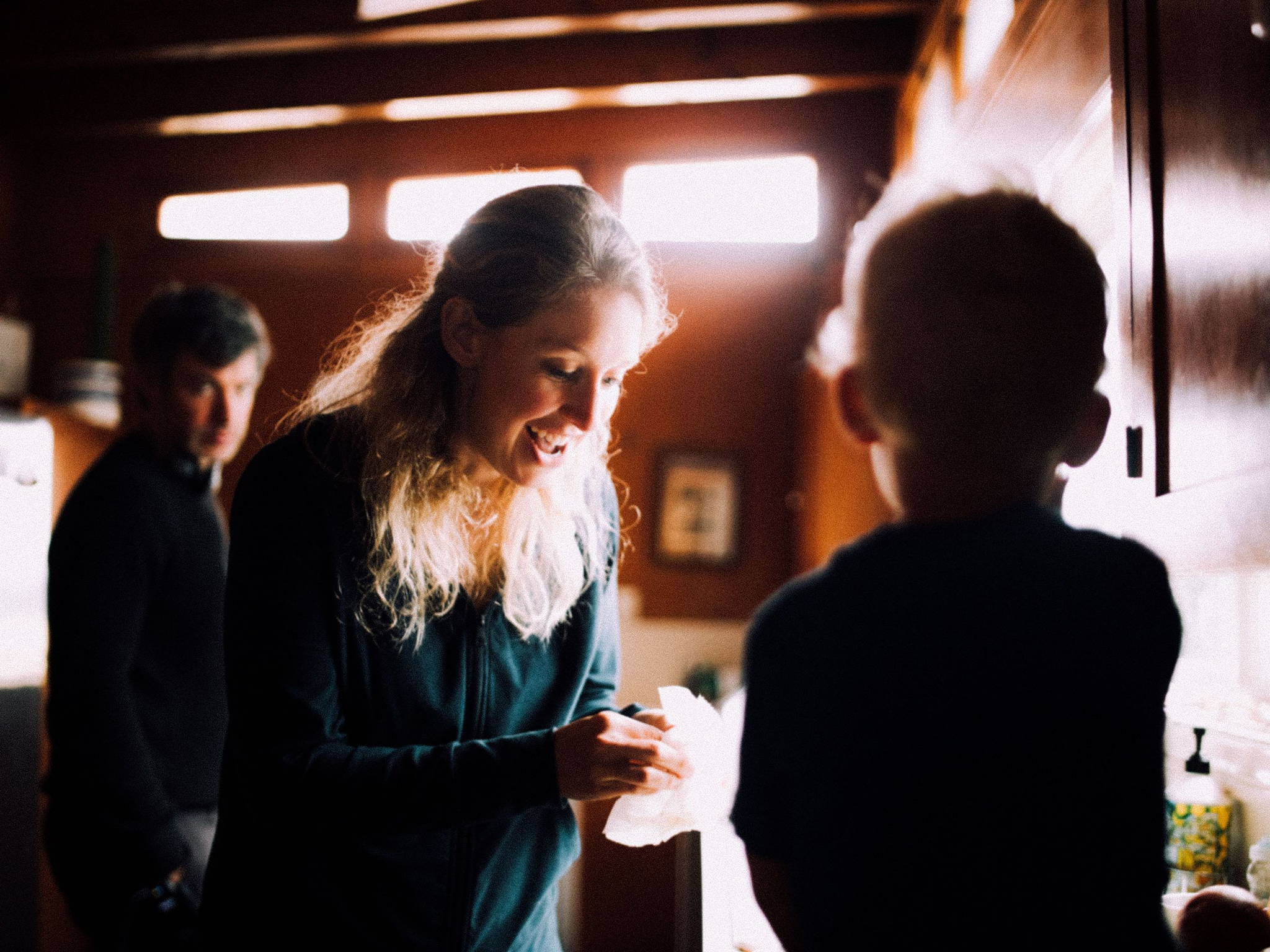
Richard Brody: I very much agree. It’s one of the trippiest documentaries I have ever seen. Fielder is not an observational documentarian—he’s an interventionist documentarian. He’s onscreen with Holmes and her family for much of the film. What we’re getting is not simply a portrait of Holmes but a portrait refracted through Fielder’s own idiosyncratic personality and approach. Without spoiling what I find to be absolutely, magnificently inventive touches, the movie then divides off from portraiture and goes into even stranger territory.
What is it like to be a critic trying to talk about an extremely weird and boundary-pushing piece of art like this?
Brody: Well, it isn’t such a new approach. If I tell you what the predecessors are, it will already be a spoiler. The general approach is not what’s so radically original. It’s the use that Fielder makes of it. And I say he because, although Oppenheim is the co-director, the film is very much in the Fielder wheelhouse. It’s very much a continuation of what he did in his television shows “Nathan for You” and “The Rehearsal.”
Fry: It’s pretty rare to have the experience where you’re this intrigued and tickled by a work of art. As a critic, it makes you want to respond to it.
Brody: I’ve seen the film twice. The first time I saw it, I kind of levitated from my seat. When I see a movie that I’m going to review, I take notes in a notebook. Taking notes at this first viewing, I filled a notebook and a half. I then tried to type them out when I got home, and found that I was writing so fast and in such a state of excitement that I simply couldn’t read my handwriting for the most part. I said to myself, How in the hell am I going to review this film?
I saw it again, and the funny thing about it is, in a certain way, it wasn’t only because of not being able to read my handwriting that I didn’t know what the hell I had seen. It’s because what I had seen is so vertiginous. It’s like one of those trompe-l’oeil carpets that makes it look like you’re standing on top of an open shaft when you’re actually standing on the floor.
Fry: It’s three hours long, but I felt very gripped. I saw it with my editor, Tyler. After it ended, we both just sat as the credits started rolling, almost exhausted. The last time I think that happened to me was at a very different sort of movie but also one that I found very affecting, very striking, and very original: Annie Baker’s “Janet Planet.” I had to sort of let it wash over me.
What are some of the questions this film is prodding at?
Fry: It’s about many things—it’s a rich text. I’m kind of loath to sum it up, but, for me, it’s about the inherent unknowability of people—the desire and the attempt to drill into another individual, to understand another individual wholly and fully, as if you were in that individual’s mind and even soul. Can I know what is in another person’s mind?
Brody: For me, one of the key subjects of the film is whether anything at all is really identifiable as truth—what it is to be expressing truth, and whether there’s actually anything verifiable in those assertions. Holmes is an infamous scammer. Because she is famous for committing fraud, Fielder is obsessed with the possibility that not a word that comes out of her mouth has any truth value, that she may be scamming all the time, and he focusses on the vast practical and philosophical implications of that possibility.
Are there aspects of the film that don’t work?
Brody: His attitude. I have had serious concerns about Fielder in his television work. To use a grossly overused and misinterpreted word, I think he’s a genius. He’s a truly original filmmaker, TV-maker, and thinker. That said, I think that there is very, very often something condescending and cruel in his attitude toward the participants in his films, as he sometimes is toward Holmes.
There’s one other thing I have trouble with, which is the way the film is shot and edited. It is edited to death, sacrificing the drama of interactions in real time.
Fry: To Richard’s first point, I agree that Fielder is a genius. I’m a great admirer of his. I also leaned over to Tyler, who was sitting next to me, and I said, with a laugh, “Oh, my God, he’s satanic.” Because Richard is right. Of course, this family invites Fielder and Oppenheim into their home. There’s no taking advantage here, but it’s a difficult situation. There are two young children. She’s about to go to jail. And then you have this character who is—again, with everyone’s full agreement—lurking and hectoring. It’s jarring, and I think intentionally so.
Is there anything else that you all are dying to talk about?
Brody: Yes, but it’s all spoilers.